
Every organisation that owns equipment, files, or vehicles eventually runs into the same problem: nobody knows exactly where everything is at any given moment. A laptop goes missing from a store room, a file is misplaced in a government office, a forklift sits idle in the wrong bay, or a critical spare part cannot be located when it is needed most.
These are not small inconveniences. They cost time and money, and in defence, healthcare, and logistics they affect safety and compliance.
RFID and Beacon technology, combined and processed through an intelligent edge device, close that gap. RFID confirms exactly what passed a specific point. Beacons report which zone an asset is in right now. Together they turn occasional stock-checking into continuous visibility.
Why manual asset tracking fails
Most organisations still track assets with spreadsheets, manual registers, or barcode stickers that someone has to scan by hand. Every one of those methods depends on a person remembering to update a record.
The moment someone forgets, the data goes stale — and stale data is almost as bad as no data. By the time a discrepancy surfaces during an audit, the asset may already have been misused, lost, or stolen.
What organisations need instead is tracking that runs automatically and continuously, without depending on manual effort.
What RFID does
RFID stands for Radio Frequency Identification. Think of it as a wireless, smarter version of a barcode.
A small RFID tag is attached to an asset — a file, a book, a machine, a vehicle, or an employee ID card. Unlike a barcode, the tag does not need to be presented to a scanner one item at a time. An RFID reader at a gate, gantry, or workstation detects the tag automatically as soon as it comes within range, often from several metres away, and reads many tagged items passing together.
That makes RFID highly reliable for pinpoint identification at specific checkpoints: exactly which file left a records room, which vehicle passed the factory gate, or which library book was issued to a student.
What Beacon technology does
A beacon works on a different principle. It is a small battery-powered device that continuously broadcasts a Bluetooth Low Energy (BLE) signal.
Rather than waiting for something to pass a fixed checkpoint, beacons are placed throughout a building — across rooms, floors, or zones. The system estimates where a tagged asset or person currently is based on which beacon signal is strongest nearby.
In short: RFID tells you “this asset just passed through this exact gate.” Beacon tells you “this asset is currently somewhere in this zone.” One gives checkpoint precision; the other gives continuous area-level awareness.
RFID and Beacon compared
| Factor | RFID | Beacon (BLE) |
|---|---|---|
| What it answers | What passed this exact point, and when | Which zone an asset is in right now |
| Accuracy | Pinpoint, at the reader | Zone or room level |
| Coverage | Fixed checkpoints, plus on-demand handheld scans | Continuous across covered areas |
| Tag power | Passive tags need no battery | Battery powered |
| Best suited to | Gates, doors, gantries, workstations | Open floors, wards, storage zones |
Why combining the two changes the outcome
Used alone, each technology leaves a gap.
- RFID alone tells you what happened at fixed points, but nothing about what happens in between them.
- Beacons alone tell you the general area an asset is in, without the pinpoint certainty RFID gives at a chokepoint.
Combined, an organisation gets continuous real-time visibility of roughly where assets are, plus accurate checkpoint-level confirmation of identity and movement wherever it matters most.
A hospital, for example, can know that a particular ventilator is somewhere on the third floor at all times through beacons, while RFID readers at ward entrances confirm exactly when it entered or left a specific ward.
The role of the POXO edge device
Collecting signals from hundreds of readers and beacons across a large facility is only useful if that data is processed intelligently and delivered where it is needed, instantly.
A basic gateway simply forwards raw signals to a central server, leaving the thinking to happen elsewhere, often after a delay. The POXO edge device does meaningful processing at the location where the data is generated:
- Filters noise and duplicate reads before they reach the central platform.
- Recognises patterns and unusual movements as they happen.
- Triggers instant alerts when something needs attention — an asset leaving a zone it should not, or a tag not detected where it was expected.
- Sends only clean, structured data upward to the central software platform.
Because this intelligence sits close to the assets, alerts and decisions happen in real time, without waiting on a distant server or depending on a constant high-bandwidth internet connection.
In practice that means fewer false alarms, faster response when something genuinely goes wrong, and a system that keeps working in facilities with patchy connectivity — common across large industrial sites, defence establishments, and government campuses.
How it works together: a warehouse example
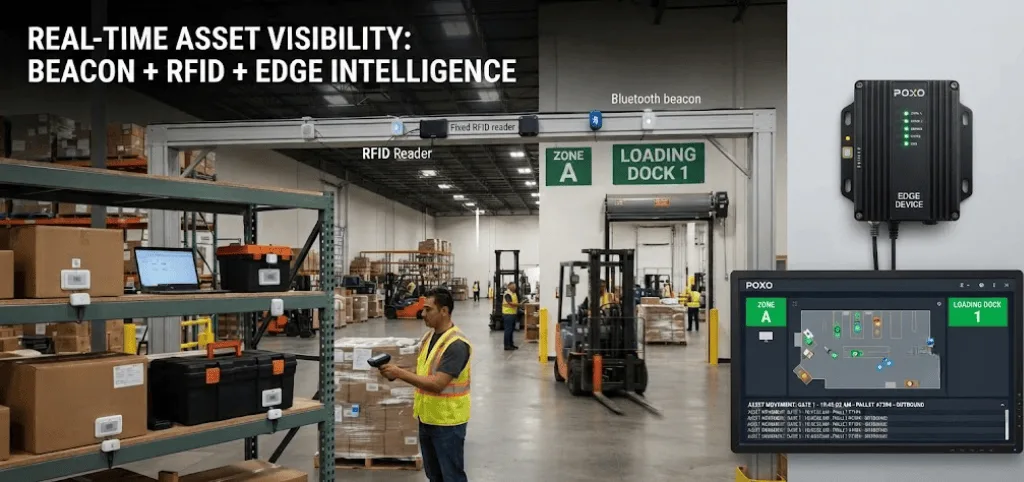
Picture a large logistics warehouse. Every pallet carries an RFID tag, and beacons are installed across the storage zones.
- As a pallet moves through the warehouse, beacons continuously sense which zone it is in, giving the operations team a live map of stock movement.
- When that pallet passes the loading gate, a fixed RFID reader confirms its exact identity and logs the precise time it left the building.
- The POXO edge device on site gathers both streams, cleans the data, and checks it against expected rules.
- A clear, accurate update is pushed to the central dashboard.
A warehouse manager or a regional supervisor can then see which zone every pallet is in and every checkpoint it has passed — without a single manual entry.
Where this is being used
This combination is already proving valuable across several sectors:
- Defence and government facilities — tracking sensitive files, weapons, and equipment with a verified audit trail.
- Hospitals — locating expensive shared equipment such as wheelchairs, infusion pumps, and monitors that get misplaced between wards.
- Manufacturing plants — tracking tools, work-in-progress material, and vehicles moving through production zones.
- Libraries and educational institutions — automating book and equipment tracking far more accurately than manual registers allow.
The real benefit is confidence, not convenience
The value of real-time asset visibility is not knowing where things are for the sake of curiosity. It is the confidence that comes with it.
Confidence that nothing important is quietly going missing. That audits will be smooth because the data is already accurate. That problems get flagged immediately rather than discovered weeks later.
As facilities grow larger and asset inventories grow more valuable, manual tracking simply does not scale. Beacon and RFID technology, made intelligent by an edge device that does real processing rather than just passing along raw data, gives organisations a dependable way to always know where their assets are — without adding work for their teams.
Still tracking valuable assets manually? Explore POXO’s asset management solution and warehouse management, or talk to our team about a combined Beacon and RFID deployment.